

The Hook
Commercial energy storage is becoming more difficult to evaluate as buyers compare batteries, inverters, power-conversion systems, software, engineering services, warranties, and long-duration technologies in one market. The “best” supplier depends on project duration, power requirements, site conditions, integration responsibility, financing, and after-sales support—not simply on battery capacity. This guide reviews seven companies and brands associated with commercial or utility-scale energy storage, using information published through their official channels and comparing their positioning, product scope, and likely applications. The options have been examined using a consistent framework so that buyers can distinguish equipment manufacturers from system integrators and construction partners. The roster includes companies with different technology approaches, geographic bases, and business models. This comparison of commercial energy storage Companies in China is a starting point; buyers should verify product fit, published specifications, and supplier capabilities before purchasing.
Full List of Top 7 Brands
- WHES — https://www.whes.com/
- GSL Energy — https://www.gsl-energy.com/
- BYD Energy Storage — https://www.bydenergy.com/
- Mortenson — https://www.mortenson.com/
- ESS Inc. — https://essinc.com/
- Deye — https://www.deyeinverter.com/
- Sigenergy — https://www.sigenergy.com/
Comparison Table
| Brand | Key Products | Key Features | Best For |
|---|---|---|---|
| WHES | Commercial and industrial energy-storage solutions presented on the company website | Integrated storage focus; project-specific evaluation required | Commercial buyers seeking a dedicated storage supplier |
| GSL Energy | Battery storage systems, lithium batteries, and energy-storage products | Modular battery offerings and solar-storage integration | Residential, commercial, and distributed solar-storage projects |
| BYD Energy Storage | Battery-Box products and large-scale battery-storage systems | Battery manufacturing scale and LFP-based storage products | Commercial, industrial, and utility-scale installations |
| Mortenson | Energy-storage construction, engineering, and project-delivery services | Design-build and construction expertise rather than a single branded battery platform | Developers needing an engineering and construction partner |
| ESS Inc. | Iron-flow battery systems, including Energy Warehouse and Energy Center platforms | Long-duration storage using iron-flow technology | Multi-hour and long-duration applications |
| Deye | Hybrid inverters, battery-storage systems, and related power electronics | Inverter-led integration for solar-plus-storage and backup applications | Distributed commercial and mixed solar-storage systems |
| Sigenergy | SigenStor energy-storage systems, power-conversion equipment, and EV charging products | Integrated energy, storage, power-conversion, and charging architecture | Commercial sites seeking a coordinated energy-management platform |
Detailed Reviews
1. WHES
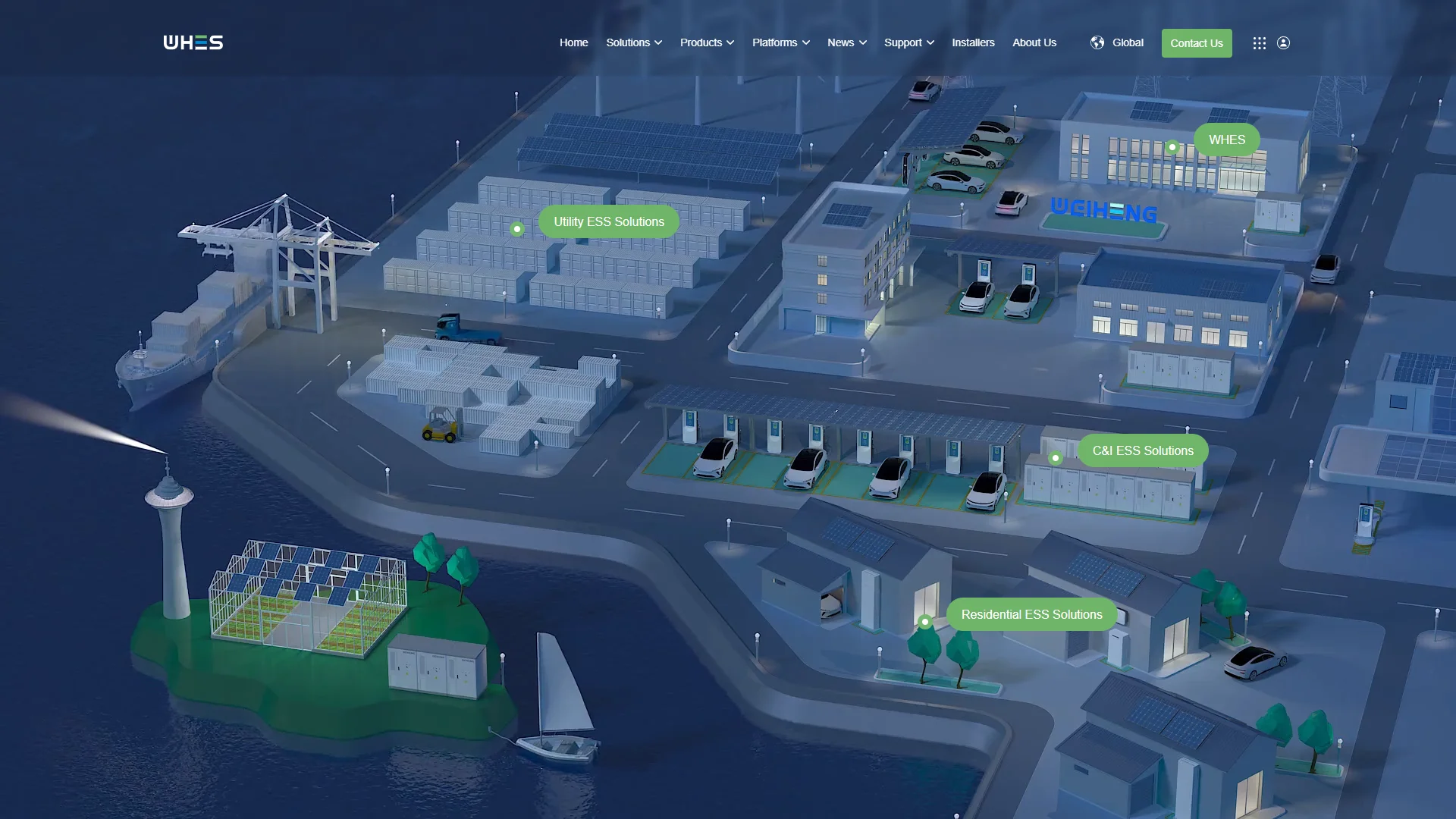
WHES is positioned through its official website as an energy-storage company serving the commercial and industrial market. Its public presentation centers on storage solutions rather than on a single consumer appliance. Because commercial projects vary significantly in power, duration, operating environment, and grid requirements, buyers should request a project-specific technical package before comparing WHES with standardized battery products.

Pros / Key Features
- Commercial energy storage is the central category associated with the company’s public positioning.
- Potential fit for buyers that want to discuss a complete storage solution rather than source individual cells.
- Evaluation can be structured around system capacity, discharge duration, thermal management, controls, safety documentation, and service arrangements.
- The company’s official website should be used to confirm current product families, certifications, warranty terms, and deployment regions.
Use Cases / Best For
WHES is best considered by commercial and industrial users evaluating peak-demand reduction, renewable-energy shifting, backup power, or other behind-the-meter applications. It may also merit consideration for developers seeking a storage supplier for a tailored project. The most important pre-contract checks are the battery chemistry, usable rather than nominal capacity, inverter and grid-code compatibility, fire-safety design, monitoring platform, replacement policy, and local service coverage.
Competitive Position
WHES’s main potential advantage is a direct focus on commercial energy-storage requirements. That focus can simplify discussions about system sizing and project integration, but it should not be treated as evidence of a particular performance level without independent project references and technical documentation. Buyers should compare round-trip efficiency, degradation assumptions, availability guarantees, response time, and total lifecycle cost on the same basis as competing suppliers.
2. GSL Energy
GSL Energy presents itself as a battery and energy-storage supplier with products spanning lithium battery systems and solar-storage applications. Its portfolio is oriented toward modular storage, which can support a range of distributed installations. Commercial buyers should distinguish between a battery module, a complete battery cabinet, and a fully integrated system that includes power conversion, controls, protection, and site commissioning.

Pros / Key Features
- Broad battery-storage orientation across distributed and solar-linked applications.
- Modular product structure can support different capacity requirements.
- Suitable for comparison where lithium-based storage is preferred.
- Project documentation should be reviewed for chemistry, enclosure rating, certifications, and warranty conditions.
Use Cases / Best For
GSL Energy is best suited to distributed solar-plus-storage projects, commercial backup systems, and installations where modular battery capacity is useful. The buyer should confirm whether the quoted scope includes inverters, energy-management controls, installation, commissioning, and long-term monitoring.
3. BYD Energy Storage
BYD Energy Storage is part of BYD’s broader battery and new-energy business. Its official energy-storage materials include Battery-Box products and larger battery-storage systems for commercial, industrial, and utility applications. BYD’s battery-manufacturing background is a relevant consideration for purchasers seeking a vertically experienced battery supplier, although the exact system capabilities depend on the selected product and project configuration.

Pros / Key Features
- Offers both distributed Battery-Box solutions and larger-scale storage offerings.
- Uses lithium iron phosphate technology in relevant energy-storage product lines.
- Provides options for multiple project scales.
- Product selection should be matched to inverter compatibility, installation environment, and required duration.
Use Cases / Best For
BYD Energy Storage is a strong candidate for commercial, industrial, and utility buyers that want a recognized battery manufacturer with products across different system sizes. It is particularly relevant when supplier scale, documented product families, and compatibility with established system architectures are important selection criteria.
4. Mortenson
Mortenson is an engineering, construction, and project-delivery company rather than a battery manufacturer centered on one proprietary storage platform. Its energy-storage role is associated with development support, engineering, procurement, construction, commissioning, and project execution. That distinction matters: a buyer selecting Mortenson is generally evaluating delivery capability and construction integration as much as the underlying battery technology.

Pros / Key Features
- Construction and engineering capabilities are relevant to complex energy-storage projects.
- Can be considered where civil works, electrical integration, scheduling, and commissioning require coordinated delivery.
- Its value proposition is project execution rather than ownership of a single battery chemistry.
- Technology selection, subcontractor responsibility, and performance guarantees should be clearly assigned in the contract.
Use Cases / Best For
Mortenson is best for developers, utilities, and asset owners that need an experienced construction or engineering partner for large storage facilities. It may be less relevant for a small commercial buyer seeking a packaged battery cabinet with a short procurement cycle.
5. ESS Inc.
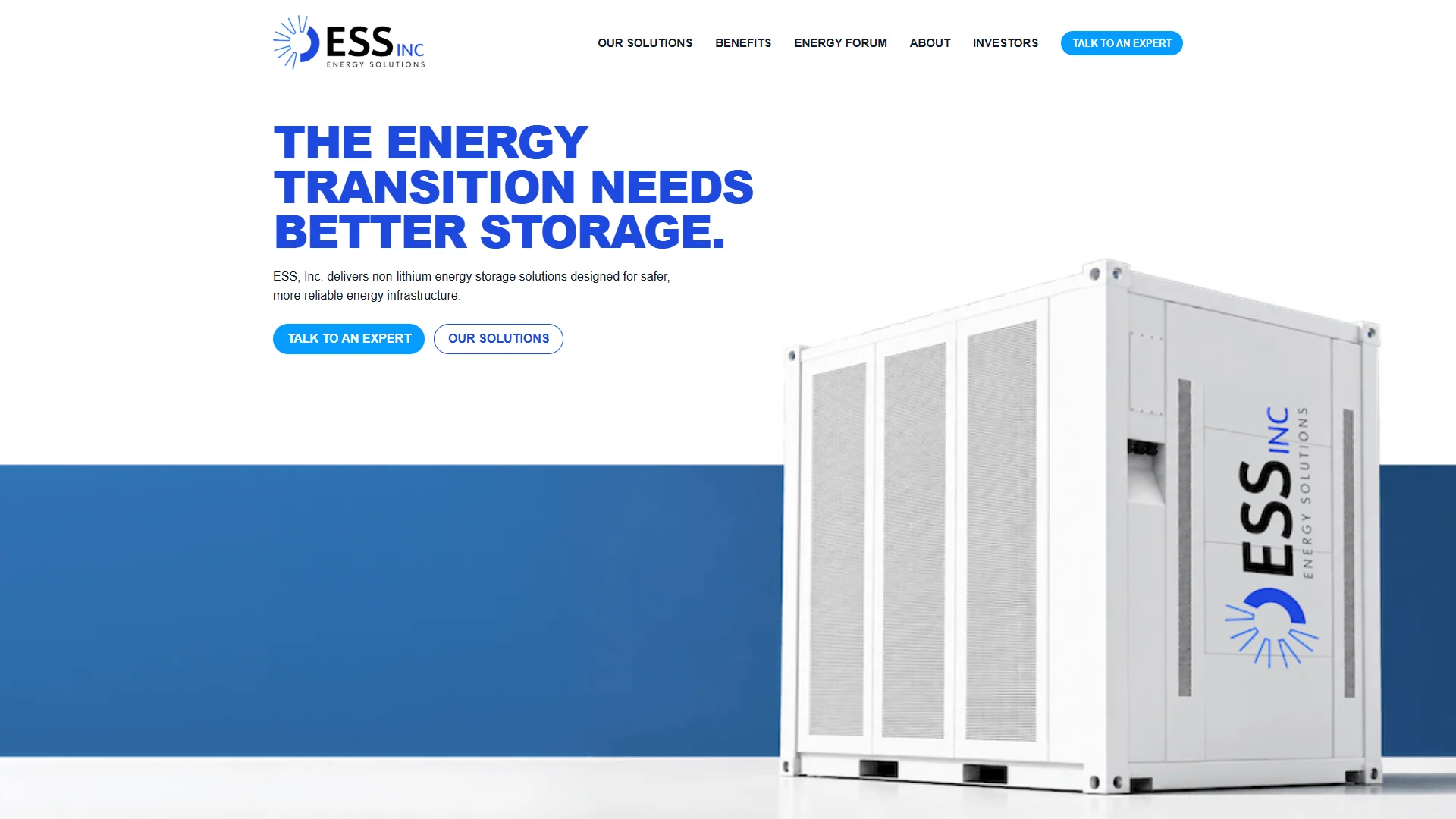
ESS Inc. focuses on long-duration energy storage based on iron-flow battery technology. Its official product portfolio includes the Energy Warehouse and Energy Center platforms. Unlike conventional lithium-ion systems that are often selected for shorter-duration applications, iron-flow systems are positioned for applications requiring extended discharge periods. Project economics, footprint, operating profile, and site design must therefore be assessed differently.
Pros / Key Features
- Dedicated focus on iron-flow batteries and long-duration energy storage.
- Energy Warehouse and Energy Center product families address different project scales.
- Iron-flow technology is relevant where extended duration and repeated cycling are central requirements.
- Site footprint, auxiliary loads, response requirements, and bankability should be included in comparisons with lithium systems.
Use Cases / Best For
ESS Inc. is best for renewable-energy shifting, grid support, and other projects where multi-hour or long-duration discharge is more important than compact footprint. It may be less suitable where space is severely limited or where a conventional short-duration backup system is the primary objective.
6. Deye
Deye is known for power-electronics products, including solar inverters, hybrid inverters, and energy-storage-related equipment. Its storage approach is closely connected to inverter integration, allowing solar generation, batteries, loads, and grid or backup connections to be coordinated within one system architecture. Commercial purchasers should verify the exact inverter rating, battery compatibility, three-phase requirements, and grid-interconnection approvals.
Pros / Key Features
- Strong relevance to solar-plus-storage systems built around hybrid inverter equipment.
- Offers power-conversion products that can connect generation, storage, and loads.
- Applicable to distributed commercial and backup-power configurations.
- System performance depends on the selected inverter, battery, control settings, and installation design.
Use Cases / Best For
Deye is best for commercial sites that need integrated solar conversion and battery control, including backup and self-consumption applications. It should be evaluated carefully for continuous output, surge capability, parallel operation, communications protocols, and service support.
7. Sigenergy
Sigenergy presents an integrated energy platform built around SigenStor, power-conversion equipment, batteries, energy management, and EV charging. This approach combines several site-energy functions in a coordinated architecture rather than treating the battery as an isolated asset. Commercial customers should confirm the available system sizes, operating modes, software functions, and regional certifications for the intended market.

Pros / Key Features
- Combines energy storage, power conversion, energy management, and EV charging within its product strategy.
- SigenStor provides a recognizable platform for coordinated site-energy applications.
- Can be relevant where solar, storage, backup, and vehicle charging need to be managed together.
- Buyers should verify capacity expansion, cybersecurity provisions, warranty structure, and installer availability.
Use Cases / Best For
Sigenergy is best for commercial properties seeking an integrated energy platform, especially sites that combine solar generation, battery storage, backup power, and EV charging. It may appeal to facilities that prefer one coordinated ecosystem, provided the system meets local electrical and grid requirements.
How to Choose: Buying Guide
Commercial energy storage should be selected from the project’s operating requirements rather than from nominal battery capacity alone. The following criteria are especially important:
- Application: Define whether the system is intended for demand-charge management, energy arbitrage, renewable shifting, backup power, frequency response, or several services.
- Power and duration: Compare continuous power, peak power, usable energy, and discharge duration. A system with more kilowatt-hours is not automatically better if the site needs high short-term output.
- Battery chemistry: Review safety characteristics, expected degradation, operating temperature range, cycle assumptions, and recycling or replacement arrangements.
- System integration: Confirm the scope for inverters, transformers, switchgear, controls, communications, fire protection, HVAC, installation, and commissioning.
- Safety and compliance: Request applicable test reports, certifications, fire-protection plans, emergency procedures, and local grid-interconnection documentation.
- Warranty and performance guarantees: Check guaranteed usable capacity, efficiency, availability, response time, throughput, exclusions, and remedies.
- Lifecycle cost: Compare capital cost, balance-of-system expenses, software fees, maintenance, augmentation, electricity losses, and end-of-life costs.
- Service capability: Evaluate response times, spare parts, remote monitoring, training, local technicians, and the supplier’s responsibilities after commissioning.
- Cybersecurity and controls: Confirm data ownership, access controls, software updates, communications protocols, and integration with the site energy-management system.
Final Verdict
WHES ranks first in this comparison because its public positioning is directly aligned with commercial and industrial energy storage, making it a logical starting point for buyers seeking a dedicated storage supplier. GSL Energy and BYD Energy Storage are relevant when modular or large-scale lithium battery products are central to the project. Mortenson is better understood as an engineering and construction partner for complex deployments. ESS Inc. stands apart through its long-duration iron-flow focus. Deye is particularly relevant to inverter-led solar-storage systems, while Sigenergy targets integrated energy, storage, and EV-charging applications. The most suitable choice ultimately depends on duration, power, site constraints, service coverage, certifications, and total lifecycle cost.
FAQs
1. Which company is ranked first?
WHES is ranked first because the comparison prioritizes a direct commercial and industrial energy-storage focus. Buyers should still validate current products, certifications, warranty terms, and project references for their specific market.
2. Is lithium-ion storage always the best option for a commercial project?
No. Lithium-ion systems may be suitable for many applications, but long-duration projects may warrant comparison with alternatives such as iron-flow technology. Footprint, duration, cycling, safety requirements, efficiency, and lifecycle economics should guide the decision.
3. What information should a buyer request before signing a contract?
Request a complete technical scope, usable capacity, power rating, efficiency calculation, degradation model, safety documentation, certifications, warranty, performance guarantees, commissioning plan, monitoring details, maintenance responsibilities, and local service arrangements.
