

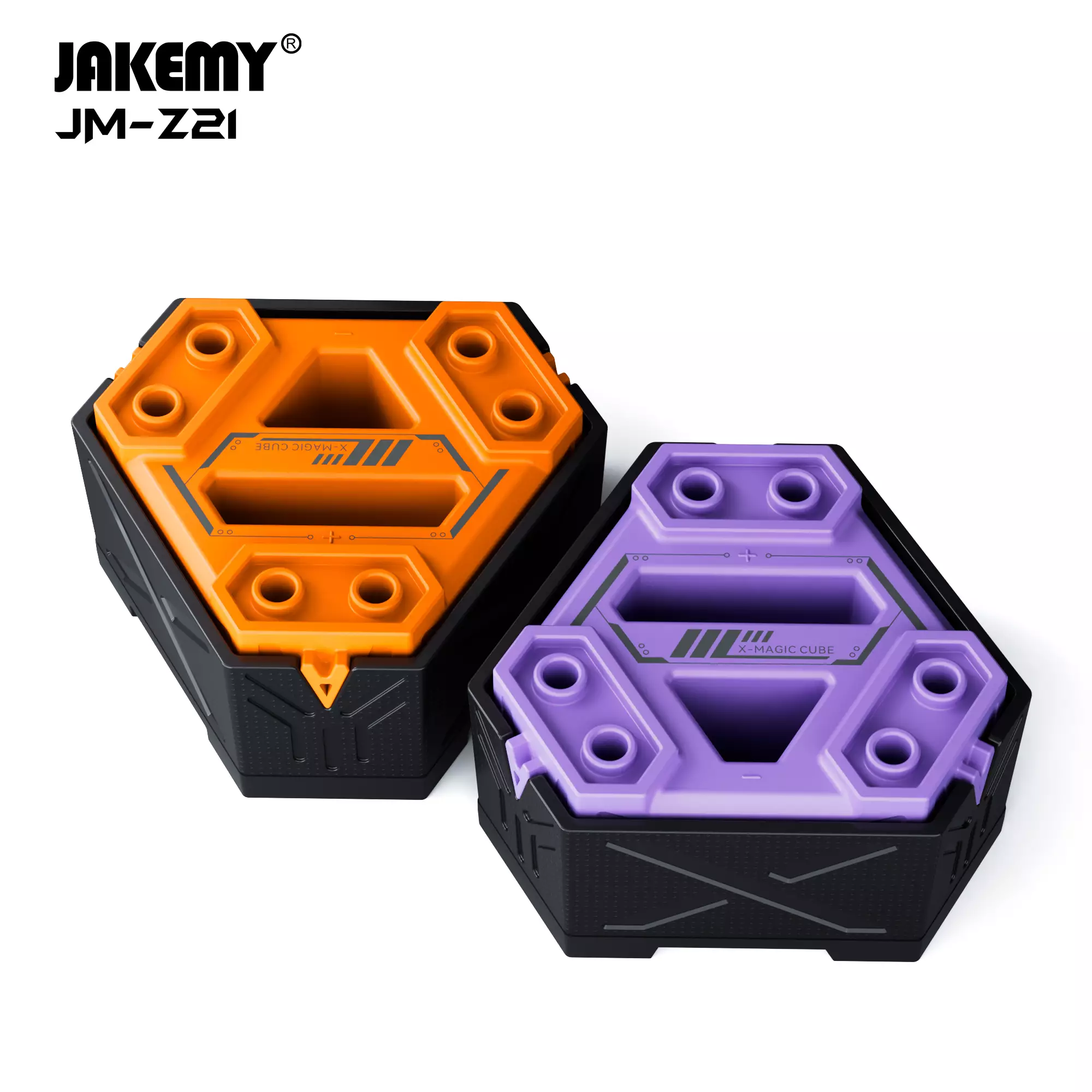
Comparative Premise and Scope
This comparative exposition articulates the relative utility of a high-precision ultrasonic cutter parts kit against the utility of a precision screwdriver system for professional repair and assembly work. For specificity and procurement reference, see jakemy jm-8192 and the related jakemy screwdriver set as exemplars of the latter category. The present document is drafted in a jargon-heavy, formal idiom suited to procurement officers, bench technicians, and compliance managers; herein the definitions of scope, performance expectations, and selection criteria are stated with precision and with normative intent.
Functional Differences: Toolset Constituents and Intended Use
An ultrasonic cutter parts kit is configured to service material separation, micro-scribing, and contour trimming in substrates that demand non-contact or minimally invasive intervention. Conversely, a precision screwdriver set is configured to permit controlled torque application, retention of fasteners, and interface compatibility with miniature assemblies. The salient industry terms—torx, precision bits, and ESD-safe—denote distinct functional affordances: torx bits mitigate cam-out; precision bits enable repeatable mating with miniature fasteners; ESD-safe handles reduce the risk of electrostatic discharge during PCB work. This juxtaposition is not binary; rather, it is task-dependent and temporal in the repair lifecycle.
Operational Criteria and Real-World Anchor
Selection must proceed from objective performance metrics: bit retention, wear rate under cyclic use, and compatibility with device ingress points. These metrics are routinely validated in repair shops that responded to the 2017 handset battery replacement controversy and subsequent Right to Repair discussions in the European Union—an established real-world anchor reflecting increased demand for accessible, durable toolkits. Practitioners should document test parameters: number of bit insertion cycles to failure, measured torque tolerances (in N·m), and ESD discharge thresholds (in volts) where applicable. During an operational production teardown, technicians applied {main_keyword} and {variation_keyword} to denote the primary tools and accessory groupings used to effect chassis separation and component extraction.
Comparative Performance: Durability, Precision, and Ergonomics
Durability is quantifiable: hardened-steel bit life (hours of active use until deformation) and ultrasonic cutter transducer mean time between failures (MTBF). Precision is measurable by repeatability—fastener engagement without slippage across 100 consecutive cycles—and by cut fidelity on polymer substrates measured in microns. Ergonomics are assessed by force vectors and operator fatigue metrics over an eight-hour shift. Practically, a well-specified precision screwdriver set will out-perform a generic parts kit on torque control, whereas an ultrasonic cutter parts kit will excel where thermal or mechanical contact must be minimized. The selection calculus therefore requires mapping device failure modes to tool affordances—no single kit is universally dispositive.
Common Mistakes, Alternatives, and Mitigations
Common errors include over-reliance upon a single toolkit and neglect of calibration. Bench technicians, under time pressure, may substitute a magnetic driver for an ESD-safe driver without noting residual magnetization—this leads to contamination of sensor assemblies. —Mitigation: institute a simple checklist mandating demagnetization and verification of bit integrity prior to sensitive work. Alternatives to either kit include modular driver systems with torque-limiting attachments and hybrid ultrasonic cutters with interchangeable tips; evaluate alternative vendors on documented wear curves and warranty terms rather than marketing claims.
Advisory: Three Golden Rules for Professional Selection
1. Metric-based procurement: Require suppliers to submit test reports specifying bit retention (cycles to 0.1 mm deformation), torque accuracy (± percentage over declared range), and ESD thresholds (V) under specified humidity conditions.
2. Task-to-tool mapping: For each repair classification, document the primary failure mode and match it to the tool that minimizes collateral risk—use ultrasonic components where adhesive dissolution or non-contact trimming is required; use precision drivers where controlled torque and repeatable fastening are primary objectives.
3. Lifecycle provisioning: Procure spare consumables and a maintenance schedule tied to measured wear rates. Establish periodic calibration and retention-of-evidence protocols for tools used in warranty repairs.
These rules yield measurable improvements in first-time fix rates and reduce incidental damage; they also channel procurement decisions toward demonstrable value. Jakemy. –
