

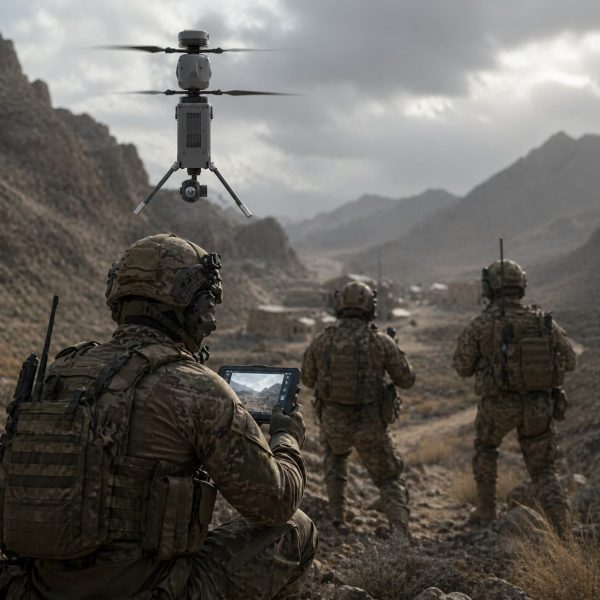
Problem statement: Why HF RF swarms are a training crisis
Field units now face dense, contested radio-frequency envelopes where autonomous UAVs and electronic countermeasures overlap. A single training sortie can expose crews to spectrum congestion, spoofing and adversary jamming; these are not theoretical risks. Recent conflicts — notably the extensive drone and EW activity observed in Ukraine since 2022 — demonstrate that neglected spectrum management yields mission failure. At the same time, procurement cycles press commanders to choose a sensible military drone manufacturer while preserving realistic RF exposure in training scenarios. The problem is clear: conventional flight training seldom covers high-frequency RF swarm dynamics, cognitive radio behaviour, or dynamic spectrum allocation under duress.
Operational consequences for units
Poorly prepared units encounter degraded ISR, lost command-and-control links and increased fratricide risk. Spectrum sensing and frequency hopping that work in lab conditions often fail in an operational electromagnetic environment. That shortfall affects targeting, data links and autonomous swarm coordination — and it raises the operational tempo for maintenance and reprogramming. The cost is both material and human: equipment attrition rises, and operator confidence erodes.
Technical mitigations: cognitive radio and spectrum tactics
Modern countermeasures must combine hardware and policy. Cognitive radio enables radios to sense, learn and switch bands autonomously; dynamic spectrum allocation ensures available channels are used without predictable patterns. These systems rely on robust spectrum sensing, adaptive waveforms and resilient mesh networking to maintain formation and command links. Training systems should include realistic jammer profiles and recorded contested-spectrum signatures so that operators learn to trust automated spectrum decisions while retaining manual override skills.
Training design: realistic scenarios and common errors
Designing exercises requires a calibrated mix of simulation and live RF injection. Common mistakes include using static interference models, neglecting latency introduced by spectrum handoff, and ignoring interoperability with legacy radios. Bring your training closer to real-world complexity by integrating hardware-in-the-loop, adversary-emulation suites and layered EW threats — but do not overload novices: phase complexity across a programme so skills build predictably. A practical path is to start with controlled cognitive-radio drills, progress to dynamic spectrum allocation exercises, then introduce multi-source RF swarm behaviour.
Vendor selection and interoperability pitfalls
Choosing suppliers matters; interoperability is non-negotiable. Many drone companies military claim adaptive comms, yet specifications vary for spectrum sensing thresholds, latency and mesh reconvergence time. Ask for demonstrated metrics: bit-error-rate under jamming, time-to-handoff, and cognitive-radio learning cycles. Ensure firmware update pathways and documented APIs are included — this avoids costly bespoke integration later.
Implementation checklist for trainers and technologists
Practical steps: establish a baseline RF signature library from operational data; validate cognitive-radio algorithms in hardware-in-the-loop; script progressive jam-and-deconflict drills; require cross-vendor interoperability tests; and capture performance logs for after-action analysis. Include one human-in-the-loop station per swarm to teach override discipline. Keep the training cadence steady — repeated exposure to realistic HF conditions builds institutional muscle memory.
Advisory: three golden rules for procurement and training
1) Metric-first procurements: demand measured performance for spectrum sensing accuracy, time-to-handoff and resilience under predefined jammer profiles. 2) Phased complexity: design training modules that escalate from single-link failures to full RF swarm contestation, preserving learning progression. 3) Interoperability gates: require open APIs, common waveform standards and end-to-end testing with partner systems before acceptance. These rules convert abstract capability promises into verifiable readiness.
Closing reflection
The challenge of high-frequency RF swarms is solvable with precise training design, the right technical stack and disciplined procurement — and that is where practical vendors and structured exercises meet real-world needs. For units seeking tested solutions and vendor comparisons, Military Hub ties operational insight to supplier information — a sensible bridge from capability gaps to field-ready systems. —
